Arrival in India
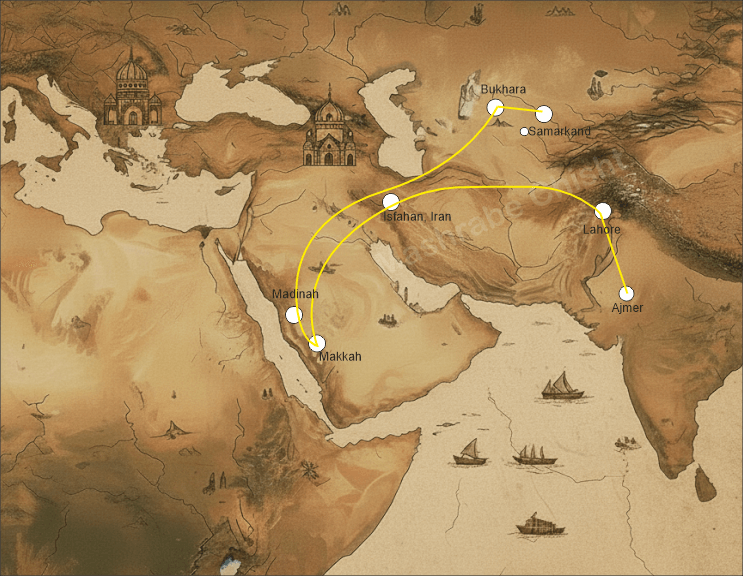
After years of companionship and spiritual training under his revered master, Hazrat Khwaja Usman Harwani رضي الله عنه, Khwaja Gharib Nawaz رضي الله عنه undertook extensive travels across the Islamic world. He visited Damascus, Baghdad, and other great centers of learning, where he met the eminent Sufis and scholars of the era. He also performed the sacred pilgrimage to Makkah and Madinah multiple times with his master. During one such blessed visit, while offering salutations at the Holy Prophet’s ﷺ shrine, Khwaja Garib Nawaz رضي الله عنه experienced a prophetic vision. The Prophet ﷺ addressed him, saying:
“O Moinuddin, you are the promoter of our religion. Proceed to Hind (India), where people are unaware of Islam. Show them the path of truth, and with Allah Almighty’s help, Islam will flourish there.”
Obeying this divine command, Khwaja Garib Nawaz رضي الله عنه began his momentous journey towards India.
Encounters on the Way
Traveling through various lands, he spread the message of peace, love, and the teachings of Islam. One of the most significant events occurred in Sabzwar, where he encountered the notorious ruler Sheikh Mohammed Yadgar, infamous for his cruelty and open hostility towards the noble Companions of the Prophet ﷺ. Khwaja Garib Nawaz رضي الله عنه entered the ruler’s famed garden, performed ablution, and engaged in prayer and recitation of the Qur’an.
When the tyrant arrived and angrily confronted him, Khwaja Garib Nawaz رضي الله عنه cast a single glance upon him. Immediately, the ruler collapsed unconscious, struck by the spiritual power radiating from the saint. Upon regaining consciousness, Yadgar was humbled, sought forgiveness, and listened attentively to Khwaja Garib Nawaz’s رضي الله عنه discourse on the honor of the Sahaba (Companions of the Prophet ﷺ). Overcome with remorse, the ruler repented, renounced his cruelty, returned the wealth he had unjustly taken, and became a devoted disciple of Khwaja Garib Nawaz رضي الله عنه. In time, he was even appointed as a caliph and given authority in Hissar, though his heart never strayed from the service of his master. His tomb today stands within the Dargah of Khwaja Garib Nawaz رضي الله عنه at Ajmer, a testament to his transformation.
Arrival and Settlement in India
Continuing his journey, Khwaja Garib Nawaz رضي الله عنه traveled through Khurasan, Isfahan, Bukhara, and Ghazni before finally reaching the Indian subcontinent. He visited Lahore and Delhi before proceeding to Ajmer, a city then under the rule of Prithviraj Chauhan. It was here that he established his center of spiritual learning and service.
Khwaja Gharib Nawaz رضي الله عنه’s presence in Ajmer marked the beginning of a new chapter for the people of India. With his humility, compassion, and divine wisdom, he opened the doors of Islam not through force or power, but through love, mercy, and service to humanity. His khanqah (spiritual lodge) became a sanctuary for the poor, the hungry, and the distressed, regardless of their caste, creed, or faith.
Propagation and Service in India
In Ajmer, Khwaja Garib Nawaz رضي الله عنه dedicated himself fully to his divine mission. His daily routine was a balance of worship, teaching, and service:
• He spent long hours in prayer, meditation, and remembrance of Allah.
• He taught Qur’an, Hadith, and spiritual sciences to seekers of knowledge.
• He fed the hungry and clothed the needy, embodying the essence of rahmah (mercy).
• He offered guidance and counsel to rulers, scholars, and ordinary people alike.
Through his unmatched compassion and spiritual magnetism, thousands embraced Islam and became his disciples. His teachings emphasized tolerance, selflessness, humility, and devotion to God. He became widely known as Sultan-ul-Hind (the Spiritual King of India), a title that reflects both his influence and his service to humanity.
Legacy in Ajmer
Khwaja Moinuddin Chishti رضي الله عنه spent the rest of his life in Ajmer, guiding people with patience, wisdom, and love until his passing in 633 Hijri. His shrine in Ajmer Sharif remains one of the most visited spiritual centers in the world, where people of all religions come to seek peace, blessings, and guidance. His mission of love, equality, and service continues to inspire millions across generations.
The Spiritual Legacy of the Chishtiya Order
The Chishtiya Sufi Order, renowned for its message of love, humility, and service to humanity, was firmly rooted in the Indian subcontinent through the spiritual efforts of Khwaja Moinuddin Chishti رضي الله عنه. Among his earliest and closest companions was the venerable Fakhruddin Gardezi رضي الله عنه, who played a vital role in supporting and spreading the mission of his spiritual companion in Ajmer. His unwavering devotion and proximity to Khwaja Moinuddin رضي الله عنه. laid the foundation for a living tradition that would span centuries.
This luminous path was then carried forward by Khwaja Qutbuddin Bakhtiyar Kaki رضي الله عنه, who established the Chishtiya Order in Delhi, where his teachings of divine love and selfless service shaped the spiritual fabric of the region. His legacy marked the beginning of a vibrant lineage of saints and scholars who preserved and advanced the Chishti message through both spiritual succession and hereditary stewardship.
Khwaja Qutbuddin Bakhtiyar Kaki رضي الله عنه
Khwaja Qutbuddin Bakhtiyar Kaki رضي الله عنه was one of the earliest and most influential Sufi saints to establish the Chishtiya Order in northern India. Born in Hijra 569 (1173 CE) in Ush, a small town near Baghdad, he was spiritually inclined from a young age and soon became a disciple of the great Khwaja Moinuddin Chishti رضي الله عنه in Ajmer.
His title "Kaki" was earned through a miraculous event: it is said that due to his complete reliance on God and refusal to ask for food or money, Allah would send bread (kak) miraculously into his house. This divine provision symbolized his utter dependence on Allah alone, a hallmark of the Chishtiya path. Khwaja"
Qutbuddin lived in Mehrauli, Delhi, during a time when the city was a growing political center. However, he consciously distanced himself from rulers and remained committed to the inner life, preferring spiritual gatherings (majalis) and periods of isolation over political association."
He was known for his deep humility, silent endurance, and intense spiritual practices. Despite attracting many followers, he never sought fame. In fact, it was during a gathering of sama‘ (spiritual music) that he entered a state of intense wajd (ecstasy) while hearing the verse:
"Those who are slain in love of God, their bodies lie scattered in the dust."
Overcome with divine longing, he passed away in this state in Hijra 633 (1235 CE), returning to his Creator in a moment of rapture."
His shrine in Mehrauli remains a spiritual sanctuary, visited by thousands who come seeking peace and blessings. Qutbuddin Kaki's teachings emphasized poverty (faqr), remembrance of God (zikr), and unwavering trust in divine will. He laid the foundation for a uniquely Indian expression of Sufism—one grounded in compassion, humility, and silent service.
The Ongoing Legacy of the Chishtiya Order
In the generations that followed, the mantle of this sacred tradition was upheld by eminent figures such as Zinda Shah Wali Hazrat khwaja Syed Khairathul hasan Chishti رضي الله عنه, Hazrat Khwaja Pir Hafiz Syed Hayathul Hasan Chishti رضي الله عنه, Hazrath Khwaja Faridul Mashaikh Pir Syed Faridul Hassan Chishti رضي الله عنه, and Hazrat Maulana Pir Syed Hammad ul Hasan Chishti, among others. Each of these noble personalities embodied the core values of the Chishtiya Order, nurturing its essence within their communities and continuing the work of their blessed predecessors with deep sincerity and guidance.
Detailed biographical accounts and teachings of these respected successors are available in a dedicated section of this website, offering a deeper understanding of their contributions to the Chishti silsila and their lasting spiritual impact.
Core Message of the Chishtiya Order
- 1. Love for all, hatred for none
- 2. Serving humanity as the highest form of devotion to God
- 3. Spiritual practice grounded in humility, simplicity, and remembrance of God (zikr)
- 4. Avoidance of wealth, power, and material entanglements